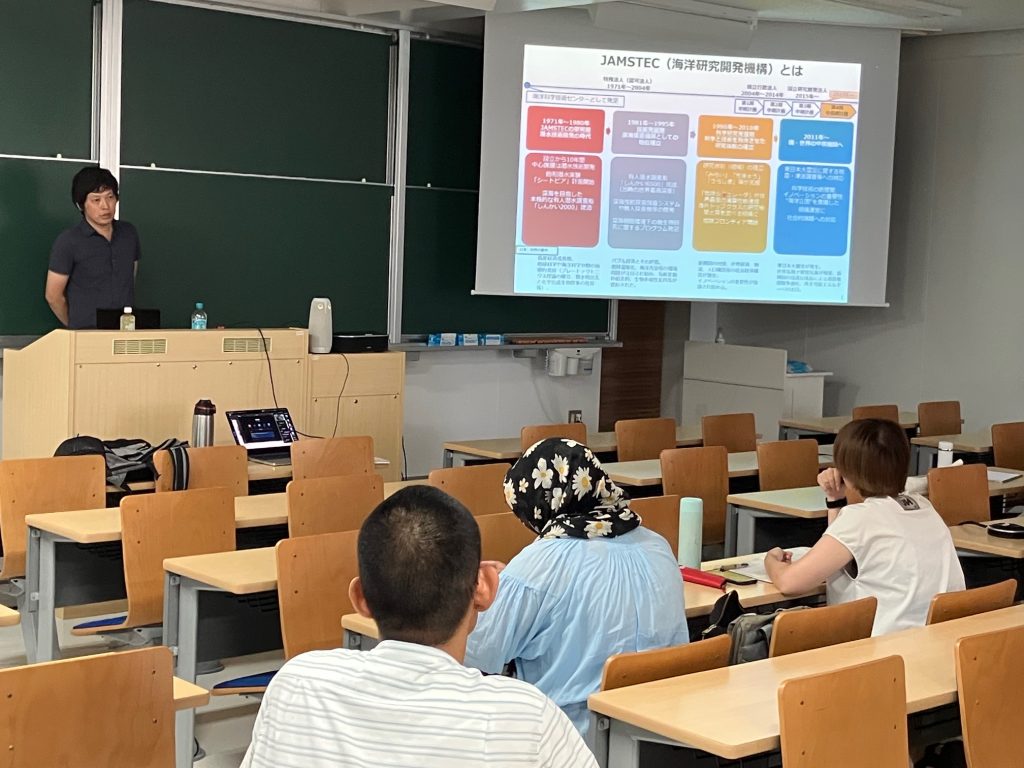
The 5th Environmental Plastics Seminar was held on Tuesday, August 20, 2026.
This study meeting aims to promote open and informal information exchange on environmental plastic pollution. It is organized throughout the year, led primarily by the Marine Science Research Group of the Environment and Food Unit. Since this fiscal year, the meeting has been continued within the framework of the Social Impact Framework (SIF) as part of the socially oriented research and development program “Environmental Plastics Research Complex (EPReC),” launched by the FS.
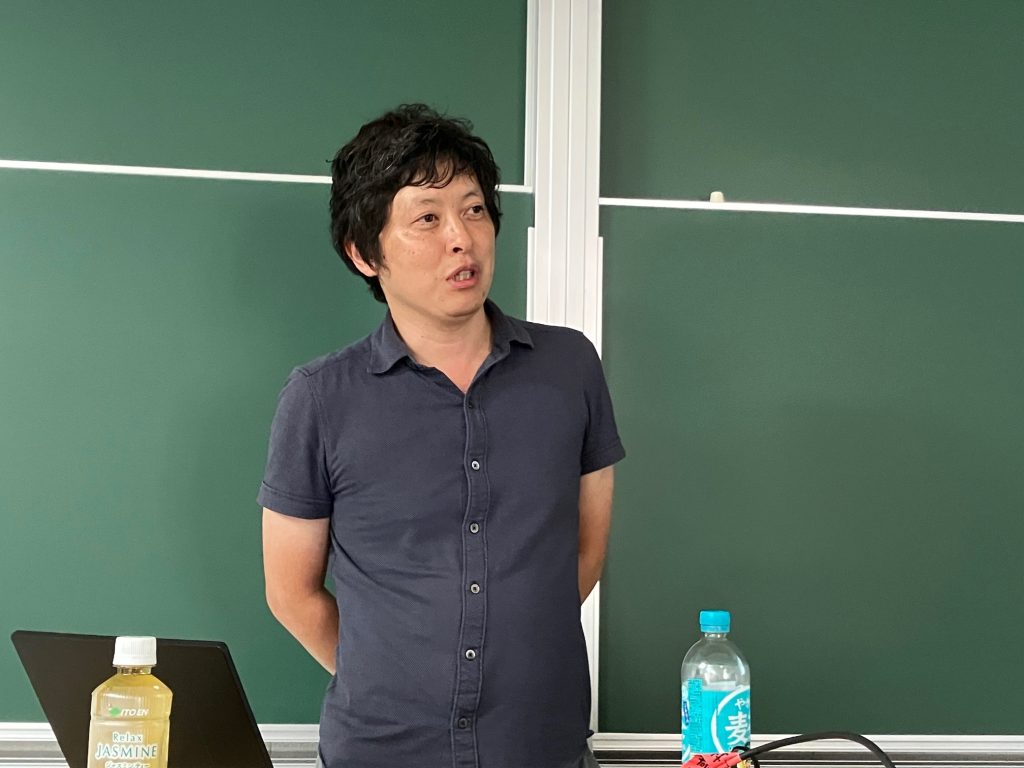
This time, we were pleased to welcome Dr. Hidetaka Nomaki of the Japan Agency for Marine-Earth Science and Technology (JAMSTEC), who gave a lecture entitled “Development of New Marine-Biodegradable Materials Based on Oceanographic Knowledge and In Situ Degradation Experiments on the Deep Seafloor.”
During the lecture, Dr. Nomaki provided fascinating insights into the development of new materials that can degrade in the marine environment as alternatives to conventional plastics. The Q&A session was also very lively and engaging.
Researchers developing new materials typically conduct most of their work in the laboratory. However, Dr. Nomaki and his colleagues introduced an approach in which researchers join them aboard the deep-sea submersible Shinkai 6500 and directly observe and participate in experiments conducted on the seafloor. Such hands-on experiences can lead to deeper and more productive collaborative research.
In interdisciplinary research, researchers from different fields often work within their respective research environments without directly entering each other’s fields. This lecture demonstrated how valuable opportunities for researchers to work together in the field can be, as they foster a deeper understanding of each other’s research.
The lecture also featured numerous videos showing actual deep-sea operations, allowing us to appreciate the remarkable precision and skill involved in manipulating the delicate robotic arms of the deep-sea submersible.
While further challenges remain before such alternative materials can be fully implemented in society, we hope that opportunities to encounter and use these new materials will emerge in the not-too-distant future. To make this possible, continued advancement of research and development in this field will be essential.
Information about the next research seminar will be posted on our website.