We will post a report on the activities of student who received overseas travel support from the Integrated Initiative for Designing Future Society in 2024FY.
It seems that the overseas training program was a great opportunity for future research and career development.
Report for overseas training supported by Integrated Initiative for Designing Future Society
“Spectroscopy of photo-excited electron spins in acene molecules”
Wataru Ishii
Photochemical Technology Innovation Group2nd year of Master’s degree in Applied Chemistry, School of Engineering Kyushu University
Activities
Beginning in June 2024, we visited four laboratories in the United Kingdom and performed spectroscopic measurements of functional dye materials in each laboratory.
(1) The first three weeks were spent in Christiane Timmel’s lab at the University of Oxford,where she measured the magnetic field effects of luminescence, focusing on the magnetic compassfunction of a protein called cryptochrome in animals such as the European robin. The Timmel lab has been actively studying the spin dynamics of radical pairs produced by cryptochromes, a protein found in animals such as the European robin. However, the low stability of cryptochromes has hindered their application as magnetic compasses. Therefore, in recent years, he has been focusing on organic dye molecules with high stability, especially on the magnetic field effect properties of photoexcited triplet pairs (triplet pairs) generated in rubrene. During this visit, the magnetic field effects of
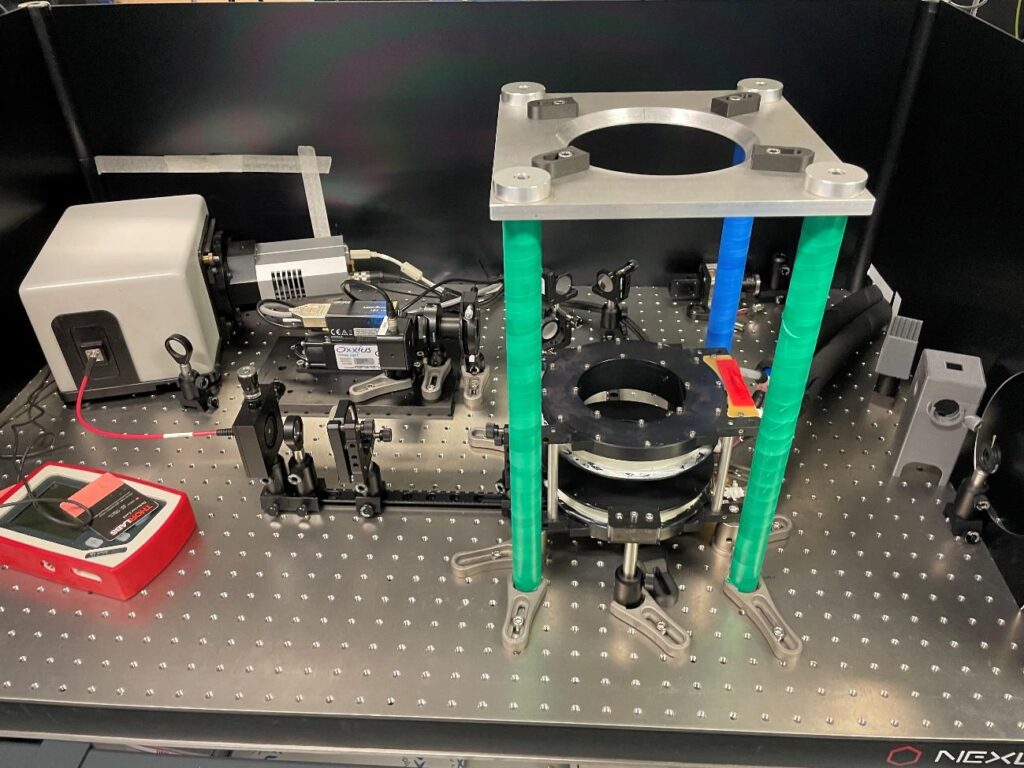
luminescence were measured for two rubrene derivatives synthesized in Yang’s lab (Photo 1).Similar to rubrene, magnetic field effects were observed for the two rubrene derivatives. Interestingly, there were marked differences between the two rubrene derivatives in terms of the intensity and linewidth of the magnetic field effect signal. These differences may depend on the triplet hopping efficiency due to the different stacking structures of the dyes in the crystal. In this study, the measurements were performed on polycrystalline thin films, and in the future, similar measurements will be performed on single crystals to establish guidelines for molecular design of rubrene derivatives as magnetic compasses.
(2) During the next two weeks, he spent time in the Jenny Clark lab at the University of
Sheffield, where he performed ultrafast spectroscopy measurements. Transient absorption measurements of luminescent dimer molecules developed in Yan Kgy’su slahbu rUevneivaelerdsi ttyhat singlet fission (SF) was taking place. Da dispersed in polystyrene. Since the concentration of immer molecules is very thin, the signal intensity was assumed to be very weak. Therefore, we first attempted to thicken the polymer film by the drop-casting method, but this resulted in strong scattering of the pump light. We then changed the fabrication method to the spin-coating method and fabricated a thinner film, which produced a sufficiently strong signal while suppressing scattering. In the future, we will attempt to elucidate SF dynamics in dimer molecules by performing time-resolved luminescence measurements in addition to transient absorption measurements.
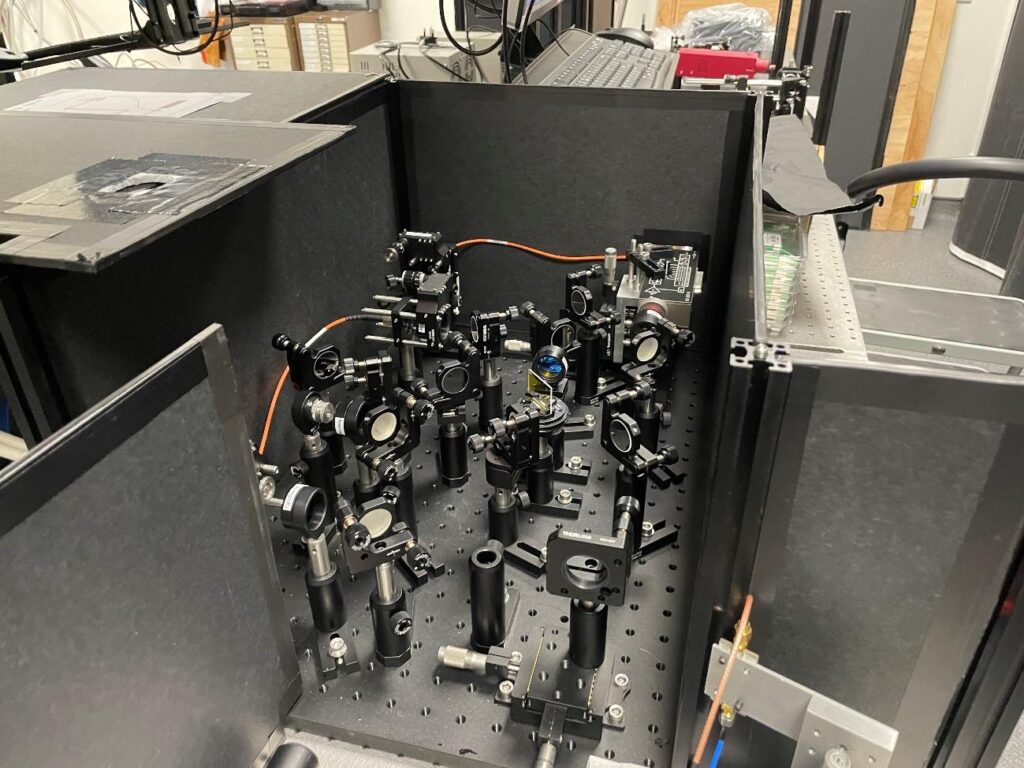
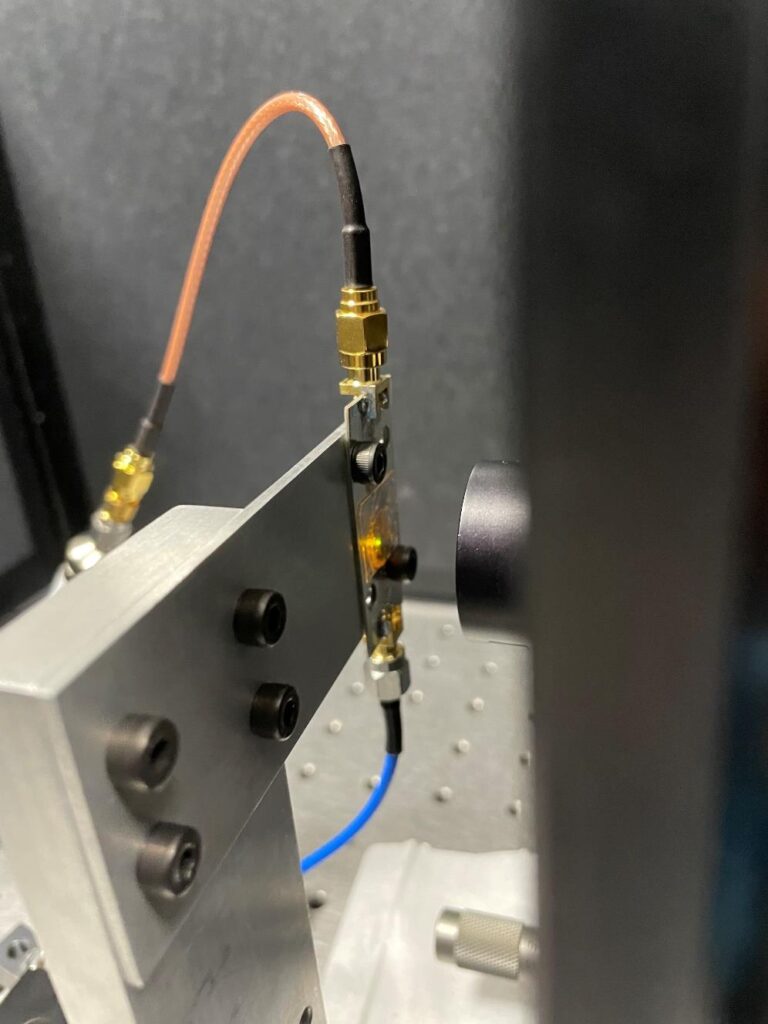
(3) After a stay in Sheffield, I went to Glasgow and stayed at the University of Glasgow for four weeks. At the University of Glasgow, I stayed in Sam Bayliss’s lab in the Department of Quantum Engineering in the Faculty of Engineering and in Gordon Hedley’s lab in the Department of Chemistry in the Faculty of Science, where I made spectroscopic measurements. This is a very interesting research field. During this stay, we attempted ODMR measurements on dimer molecules measured at the University of Sheffield (Photos 2 and 3). Since the dimer molecules are very unstable to light and oxygen, it took about two weeks to prepare the samples and optimize the ODMR setup. As a result of subsequent measurements, we succeeded in observing the ODMR signal for only one of the three dimer
molecules we brought with us. Further measurements will be performed to elucidate the spin dynamics in the dimer molecules.
(4) The Hedley lab specializes in single molecule spectroscopy, and during this stay, we measured
luminescent dimers synthesized in the Yangai lab. The goal was to decipher the dynamics of SF and its inverse process, TTA, in dimer molecules from the luminescence of single molecules. However, the luminescence intensity of the dimer molecules was not sufficient at the single molecule level, and we struggled to distinguish between noise and single molecule luminescence. Since we were able to obtain single-molecule-derived luminescence signals in some samples, we plan to optimize the measurement conditions to obtain signals with a high signal-to-noise ratio and to advance to single-molecule spectroscopy, which is called photon antibunching.
As described above, during my stay in the UK, I stayed in four physics laboratories and experienced a variety of state-of-the-art spectroscopic techniques. In addition, we obtained results that exceeded our initial expectations, and we look forward to further development of our research through international collaboration.