Environmental Plastics Research Complex (EPReC) in In2FS will hold the 1st Environmental Plastic Seminar on August 20, 2026.
EPReC aims to facilitate the exchange of information on research related to plastics dispersed in the environment, primarily targeting researchers and students both within and outside the university. We welcome participants from diverse fields, not only those studying plastics in soil, rivers, and oceans, but also those engaged in areas such as plastic waste management and bioplastic production. In addition to approaches from earth sciences, polymer science, and environmental toxicology, we also encourage the participation of researchers interested in environmental issues from a social science perspective. Of course, anyone who is simply curious or would just like to listen is also warmly welcome. Please feel free to join us.
– Program –
15:00-16:00
Lecturer: Yasuo Tsutsumi, Ph.D. (Graduate School of Pharmaceutical Sciences, Osaka University)
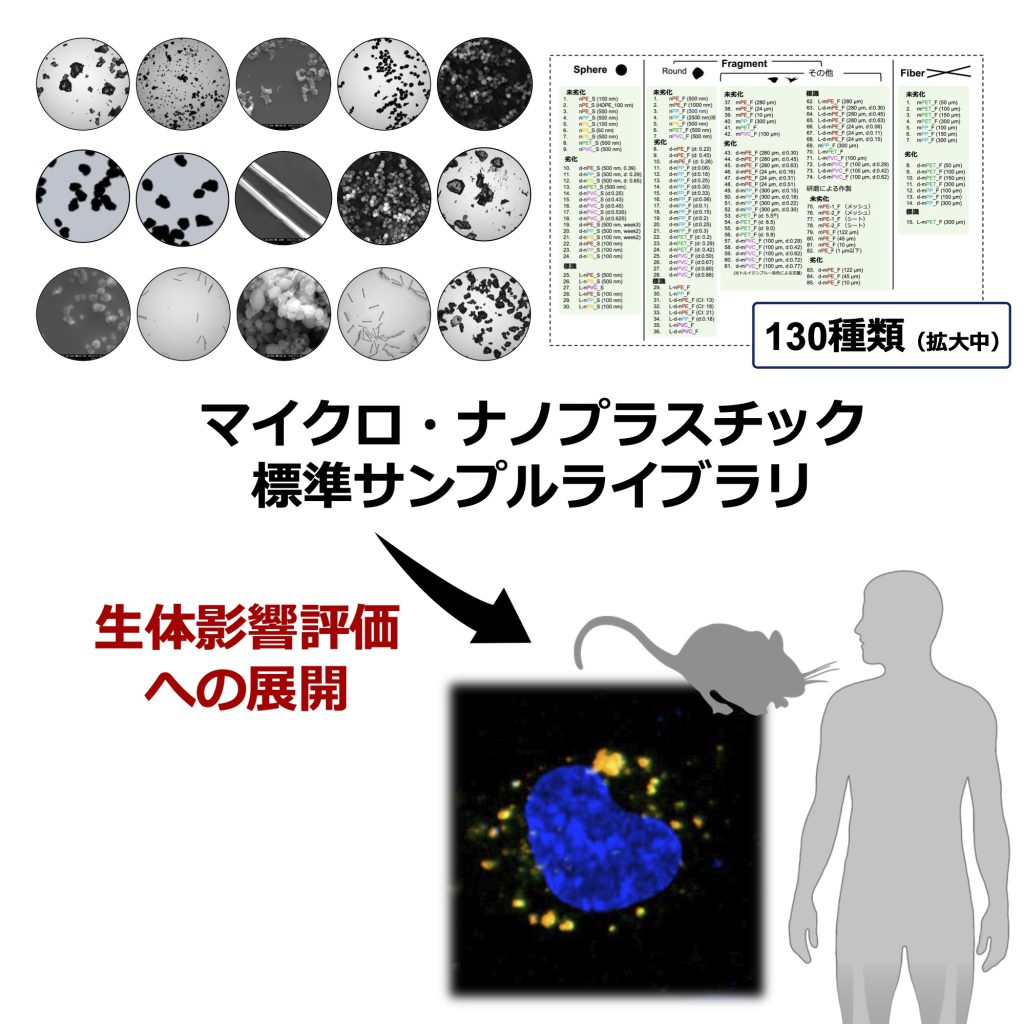
Title: Development of Standard Samples of Micro- and Nanoplastics and Evaluation of Their Biological Effects
Abstract:
As is now widely recognized, humans cannot avoid exposure not only to microplastics (MPs), defined as plastic particles smaller than 5 mm, but also to smaller nanoplastics (NPs), generally defined as particles smaller than 1 μm. Indeed, micro- and nanoplastics (MNPs) have been detected in various human tissues, including the lungs, placenta, and blood. Moreover, numerous epidemiological studies have begun to suggest associations between MNP exposure and human diseases, including the particularly high accumulation of MNPs in the brains of patients with dementia and an association between MNP accumulation in carotid artery plaques and cardiovascular events. Consequently, the potential impact of MNPs on human health has become a global concern in recent years. However, the human health risks of MNPs, which can be understood by integrating exposure levels and kinetics with their hazards, remain largely unknown.
The properties of MNPs in the environment are highly diverse. They consist of various types of polymeric materials, differing in composition and degree of branching, and also exhibit considerable variation in physical properties, including shape, size, surface characteristics such as the degree of oxidative degradation, and elasticity. Nevertheless, laboratory-based ADMET studies (absorption, distribution, metabolism, excretion, and toxicity studies) aimed at understanding the risks of MNPs often rely on particles with a single set of standardized characteristics, such as spherical polystyrene particles with smooth surfaces. This creates a substantial gap between experimental conditions and the actual complexity of MNPs in the environment.
Against this background, our group is developing standard MNP samples that reflect the complex characteristics of MNPs in the environment, including their diverse types and physical properties. We are analyzing their kinetics (ADME) following oral and inhalation exposure, while also conducting various hazard tests (T) to evaluate their potential biological effects. Although this research is still in its early stages, in this presentation I will introduce our latest findings and would greatly appreciate guidance and feedback from researchers and professionals across a wide range of fields.
16:00 – 16:30
Free discussion